NeilKant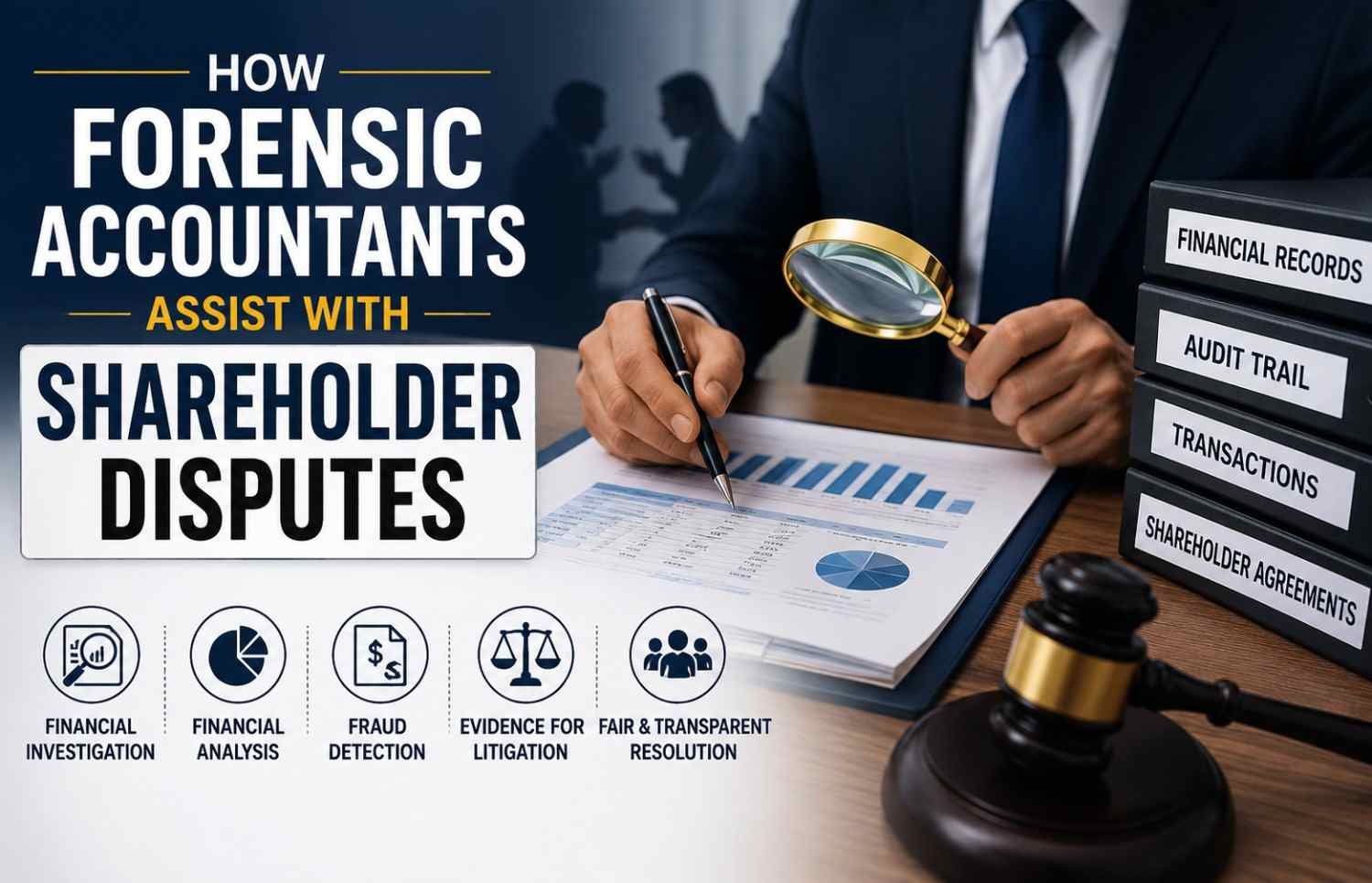
You might be feeling pulled in two directions at once. On one side, there is the business you helped build, the years of work, the trust that used to hold things together. On the other, there is a dispute that now feels personal, expensive, and hard to untangle. When shareholders stop agreeing on value, compensation, or control, even routine decisions can start to feel loaded. That is often the moment when a forensic accountant, such as a CPA in Spring Valley, NV, becomes more than a financial expert. They become a steady source of facts when the people involved no longer trust each other.
The short version is simple. How forensic accountants assist with shareholder disputes comes down to three things. They trace the numbers, test the fairness of what has been reported, and explain financial reality in a way lawyers, judges, and business owners can actually use. That does not erase the stress, but it can replace guesswork with evidence, and that shift matters.
Why do shareholder disputes become so hard to resolve?
Most shareholder fights do not start with spreadsheets. They start with suspicion. One owner feels shut out. Another believes profits were understated. Someone thinks the business was valued too low for a buyout, or too high when damages are claimed. Because of this tension, you might wonder whether the problem is legal, financial, or personal. In truth, it is often all three at once.
This is where shareholder dispute forensic accounting helps. A forensic accountant reviews financial statements, bank records, tax returns, payroll, expense reports, ownership records, and internal communications to see whether the story matches the numbers. If a shareholder claims money was diverted, the accountant looks for tracing evidence. If the issue is a buyout, they examine whether the valuation method was sound and whether the inputs were fair.
That matters because valuation fights are rarely just about arithmetic. Courts and parties may disagree about discounts, future earnings, owner compensation, and whether a minority interest should be treated differently. Research on business valuation in litigation shows how legal standards and financial methods can pull in different directions, which is one reason these disputes become so contested. You can see that tension in this discussion of business valuation and legal process.
What does a forensic accountant actually do in a shareholder dispute?
If you are in the middle of this, you do not need abstract theory. You need to know what gets done. A forensic accountant usually starts by identifying the core claim. Is this a disagreement over company value, hidden income, excess compensation, misuse of company funds, or breach of fiduciary duty? Once the issue is clear, the work becomes focused.
They may reconstruct financial records if the books are incomplete. They may normalize earnings by adjusting for unusual expenses, owner perks, or one time events. They may test whether related party transactions were legitimate or designed to move value away from one shareholder. In some cases, they prepare expert reports for settlement talks or testimony at trial.
So, where does that leave you if both sides have their own numbers? It means the dispute often turns on which analysis is more credible, more transparent, and more grounded in accepted valuation practice. Questions about conflicting valuation approaches are receiving growing attention in legal scholarship, including this review of conflicting values in judicial valuations. When a forensic accountant can explain not just the result, but why that result makes sense, they help reduce room for spin.
How can financial evidence change the outcome of a shareholder fight?
Think about a common scenario. One shareholder is being forced out and is offered a price based on earnings that seem oddly low. Without expert review, it may be hard to tell whether the company truly slowed down or whether expenses were inflated to depress value. A forensic accountant can test that by comparing historical trends, industry benchmarks, cash flow patterns, and management decisions.
In another case, a shareholder may claim that distributions were unfairly withheld while insiders received benefits in other forms. That is not always obvious from a standard profit and loss statement. A forensic accounting expert can trace compensation, loans, reimbursements, and personal expenses run through the company. Those details can shape settlement leverage and, in some cases, the court’s view of credibility.
Courts often rely heavily on the quality of financial evidence presented. A recent appellate opinion involving valuation and shareholder issues shows how much can turn on the facts, the methodology, and the explanation supporting them. You can review that here: Jayawardena v. Daka.
Should you handle the numbers alone or bring in a forensic accounting expert?
It is tempting to rely on your regular accountant, internal controller, or your own review of the books. That may work for routine questions, but shareholder disputes are rarely routine. They involve competing incentives, legal standards, and a need for defensible analysis.
| Approach | What It May Help With | Main Risk |
|---|---|---|
| Reviewing records on your own | Spotting obvious gaps, gathering basic documents, understanding the timeline | Missing hidden patterns, unsupported assumptions, or issues that affect valuation and damages |
| Using a regular accountant | Explaining bookkeeping entries and tax filings | Lack of litigation focus, limited experience with tracing, damages, or expert testimony |
| Hiring a forensic accounting expert | Independent analysis, valuation review, tracing funds, expert reporting, and testimony | Upfront cost, though that cost may prevent larger losses or a weak settlement position |
The value of a forensic accounting expert is not only in finding problems. It is also in ruling out weak claims before you spend more money chasing them. That kind of clarity can save time, legal fees, and emotional energy.
Also Read: How Certified Public Accountants Support Real Estate Transactions
What can you do right now to protect your position?
1. Gather the full financial picture. Start collecting shareholder agreements, tax returns, general ledgers, bank statements, payroll records, board minutes, and prior valuations. Do not rely on summaries if source documents are available.
2. Write down the timeline. Note when the dispute started, when access changed, when compensation shifted, and when unusual transactions appeared. A clear timeline helps connect financial events to business decisions.
3. Get an independent review early. A prompt review by a forensic accountant can identify what matters, what does not, and where your strongest evidence sits. Early clarity often leads to better strategy, whether you are negotiating or preparing for court.
When the numbers feel personal, how do you move forward?
Shareholder disputes are rarely just about money, even when money is all anyone talks about. They can carry disappointment, anger, and fear about what comes next. Still, facts have a calming effect. When the numbers are tested carefully and explained clearly, you are in a better position to make decisions that protect your business and your future.
If you are facing a dispute over ownership, valuation, or misuse of company funds, getting support from a forensic accountant can help you move from suspicion to proof and from confusion to a plan.